

Rethinking Battery Health Assessment in a Data-Constrained EV Ecosystem
As India’s electric mobility ecosystem matures, attention is shifting beyond adoption to a more complex question: what happens to batteries over time?
Battery health is now central to multiple decisions—resale valuation, service interventions, second-life deployment, and recycling pathways. Yet, despite its importance, battery health remains one of the least standardized and most misunderstood aspects of the EV ecosystem.
This gap is increasingly becoming a bottleneck for circularity.
Battery Durability is improving. Transparency is not.
Recent large-scale studies suggest that battery degradation may not be the systemic risk it was once assumed to be.
An analysis of over 8,000 EVs across 36 manufacturers found1:
- Average battery health of ~95% across all ages
- Even 8–9-year-old vehicles retaining ~85% capacity
- Weak correlation between mileage and degradation
This fundamentally shifts the narrative, since it is becoming increasingly clear that the key issue is transparency of data, not battery durability. Emerging research highlights a deeper issue: the metric most widely used to represent battery health — State of Health (SOH) — is often unreliable.
A cross-manufacturer study of over 1,100 EVs found that2:
- Real capacity differences of 12–25% exist between similar vehicles, but are not reflected in reported SOH
- Correlation between BMS-reported SOH and actual battery capacity can be near zero in many cases
- In some platforms, SOH is not exposed at all to users or third-party systems
In other words, while batteries may be performing well,
our ability to measure and communicate their condition remains inconsistent and opaque.
This creates a critical gap. This gap between actual battery performance and reported health is where better frameworks become necessary.
As market evidence shows, uncertainty around battery condition, not actual degradation, is now the key factor shaping resale value and buyer confidence.
The Hidden Friction in the EV Value Chain
Unlike internal combustion engine (ICE) vehicles—where resale valuation is well understood—EV resale is fundamentally different. The battery alone contributes up to 50% of vehicle value, but its condition is difficult to assess reliably.
In practice, this leads to:
- Conservative or inaccurate pricing
- Reduced buyer confidence
- Slower resale cycles
- Premature battery replacement
Compounding this challenge is the lack of standardized definition for battery health: Today, battery health is largely equated to the State of Health (SOH)—typically defined as the ratio of current usable capacity to the original capacity.
While this is a useful metric, it is inherently restrictive. It answers only one question: “How much energy can the battery store?”
But real-world battery performance depends on much more than just capacity. Two vehicles with identical SOH can behave very differently because:
- Power capability differs: Internal resistance and degradation modes can limit how much power the battery can deliver, even if capacity is intact.
- Usage history matters: Fast charging, deep discharge cycles, thermal exposure, and operational stress can impair performance without immediately reducing capacity.
- Operational efficiency varies: Voltage behavior, imbalance, and thermal characteristics can impact usable energy in real conditions.
In essence, SOH captures “how much,” but not “how well.”
However, even the “how much” is not always represented reliably in practice.
In real-world conditions, SOH is derived from proprietary algorithms within the battery management system. These estimates can vary significantly across manufacturers and are not always calibrated to reflect actual capacity or performance.
This leads to situations where:
- Batteries with meaningful differences in actual capacity report very similar SOH values
- SOH values remain clustered near 100%, even as underlying degradation begins
- In some cases, SOH is not accessible at all to users or third-party systems
As a result, the reported SOH can mask important differences in battery condition.
Two batteries with similar SOH may:
- Exhibit different performance characteristics
- Be at different stages of degradation
- Require different operational or service decisions
This makes SOH difficult to use as a consistent and comparable indicator of battery health across vehicles and use cases.
In sum, SOH is a backward-looking and in practice, may not consistently reflect true battery condition. At best, it may reflect what the battery has lost, and even that is not reliable. Further, it says very little about what comes next.
Battery Health Comparison
| Type | Vehicle# | ODO (km) | Age (months) | SOHQ (%) | Range* (km) | oorja Health Index |
| Type A | 1 | 17,615 | 42 | 99.51 | 260 | 0.76 |
| 2 | 38,986 | 39 | 99.5 | 286 | 0.85 | |
| Type B | 1 | 25,000 | 33 | 98.4 | 177 | 0.91 |
| 2 | 28,217 | 34 | 98.07 | 159 | 0.83 | |
| 3 | 24,412 | 48 | 98 | 176 | 0.92 | |
| 4 | 21,706 | 35 | 98.2 | 169 | 0.89 |
Table 1. Capacity alone can misrepresent battery condition. Results from actual vehicles tested on-field. Vehicles may have the same SOH but different performance
In practice:
- Two batteries with the same SOH today can age at very different rates going forward
- One may remain stable, while another may be on the verge of accelerated degradation
- Early signs of failure modes (e.g., lithium plating, cell imbalance, localized damage) are often invisible in capacity-based SOH
This means SOH does not capture the battery’s trajectory, which is essential for decisions like:
- Resale valuation
- Warranty risk estimation
- Second-life suitability
- Maintenance planning
One way to mitigate this challenge is continuous monitoring of the vehicle battery data. However this approach also has its limitations.
Why is over reliance on data impractical?
A common approach to battery health assessment relies on continuous telemetry—tracking battery usage over time.
While theoretically robust, this approach faces real-world constraints:
- Data availability is inconsistent
- Infrastructure costs are high
- Data ownership and interoperability remain unclear
- Decisions often occur without historical data
As a result, relying solely on long-term data accumulation creates a mismatch with how decisions are actually made in the field.
A New Paradigm for Battery Health Estimation: On-Demand Diagnostics and the oorja Health Index
As discussed earlier, battery health is often reduced to a single number, typically State of Health (SOH). While useful, this captures only one aspect of performance: how much energy a battery can store.
The Oorja Health Index takes a broader view. It combines multiple indicators including capacity, resistance, imbalance, and usage patterns to provide a more complete picture of battery condition.
Rather than reporting isolated metrics, the framework translates these signals into actionable decision-relevant insights, such as:
- Whether a battery requires intervention
- Its ability to deliver reliable performance
- Its remaining useful life and residual value
At oorja, we have developed an on-demand, short-duration diagnostic approach that directly assesses battery condition. By integrating physics-based models with data-driven techniques, it delivers reliable insights without requiring extensive historical data.
These tests typically involve:
- A controlled charging or discharging protocol
- Measurement of voltage and current response
- Interpretation using physics-based models
From a short test, it is possible to estimate:
- Total available usable capacity
- Internal resistance
- Cell-level imbalance and other critical performance characteristics
| Attribute | oorja- Short Diagnostic Test | Full Charging Test (Reference) |
| Test Duration | ~25–30 minutes | 7-10 hrs |
| Charging Protocol | oorja defined protocol | AC charging from 20-100% SoC |
| Infrastructure/ Equipments | DC or AC Charging | AC Charging |
Table 2. oorja Short vs. Full Charging Tests
This represents a shift from data accumulation to targeted measurement.
What Field Data Reveals?
We have performed extensive validation across vehicle makes in different geographies and for both NMC and LFP variants. Short-duration diagnostic tests can estimate capacity within ~0–1.5% of full-charge reference measurements, demonstrating high accuracy without long-duration testing.
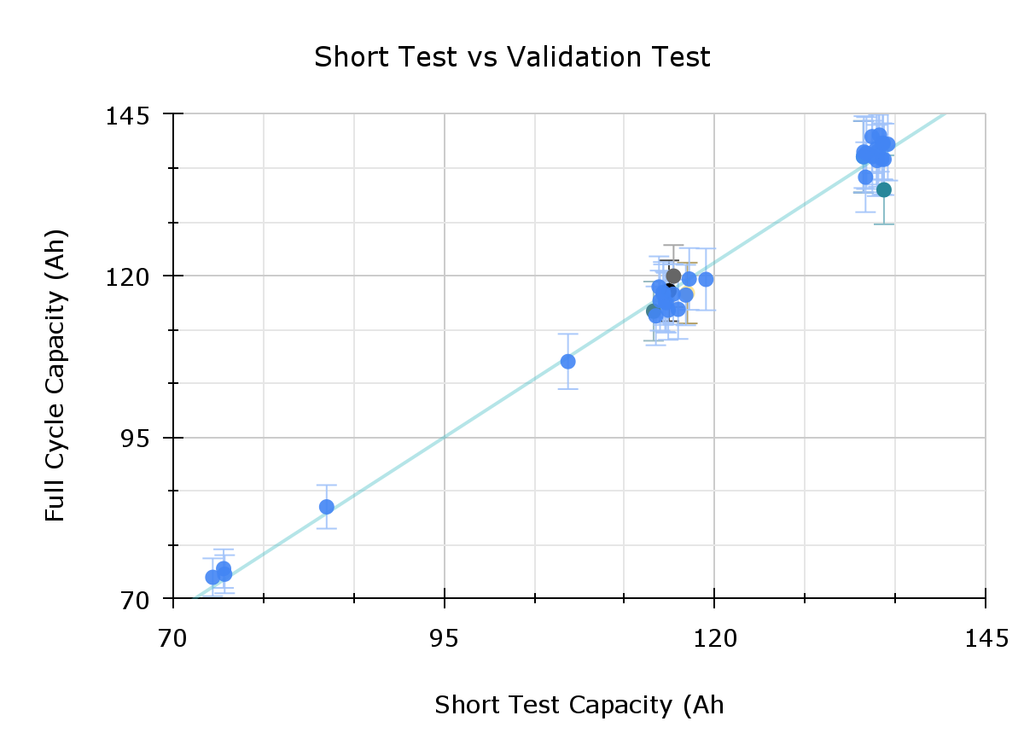
Figure 1. Short-duration diagnostics match full-cycle measurements within ~1–1.5% error. Validation performed on over 30 passenger vehicles.
Field data also shows that real-world issues are better explained through multi-dimensional diagnostics. Some batteries with high SoH still exhibit instability, while others perform reliably despite moderate SoH.
Additionally, usage and age are not reliable predictors. Low-usage vehicles can exhibit poor health, while high-usage vehicles may remain stable.
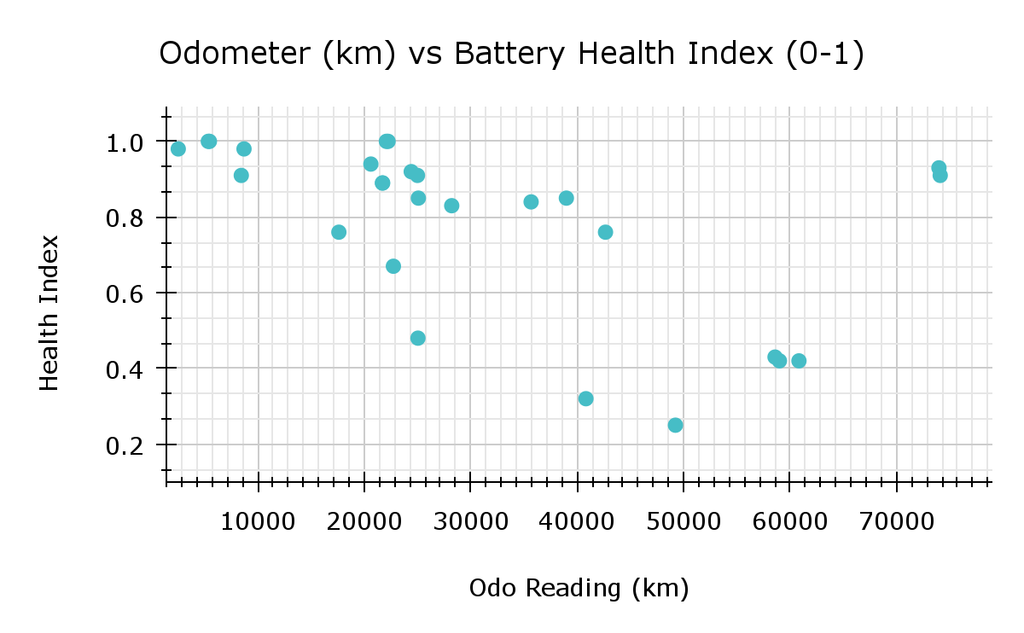
Figure 2. Correlation between odometer reading and battery health index. Age and mileage covered are not the sole indicator of health
Implications for the Ecosystem
Reliable battery health assessment can:
- Strengthen resale markets through transparent pricing
- Improve service decisions and reduce unnecessary replacements
- Enable second-life applications
- Support policy and standardization
Towards a Practical Framework
Battery health assessment must be:
- Standardized
- Accessible
- Actionable
This requires hybrid approaches combining diagnostics, physics-based models, and contextual interpretation.
Conclusion
Battery health is a foundational enabler of a circular EV economy. On-demand, physics-grounded diagnostics offer a practical pathway to reduce uncertainty, improve decision-making, and unlock value across the lifecycle. The industry is not constrained by battery performance but by the ability to measure, interpret and act on it.
As EV adoption scales, integrating such approaches into broader frameworks will be critical for building trust and enabling circularity.
References
1Zecar. (2026). How Durable Are EV Batteries? Landmark Study Delivers Answers.
2Park, J., Kim, K., Geum, S., Lee, J., Son, H., & Han, S. (2026). Battery health reporting fails independent validation across manufacturers.


